How to Trade Meme Coins With a Tiny $10 Portfolio Without Getting Eaten by Fees
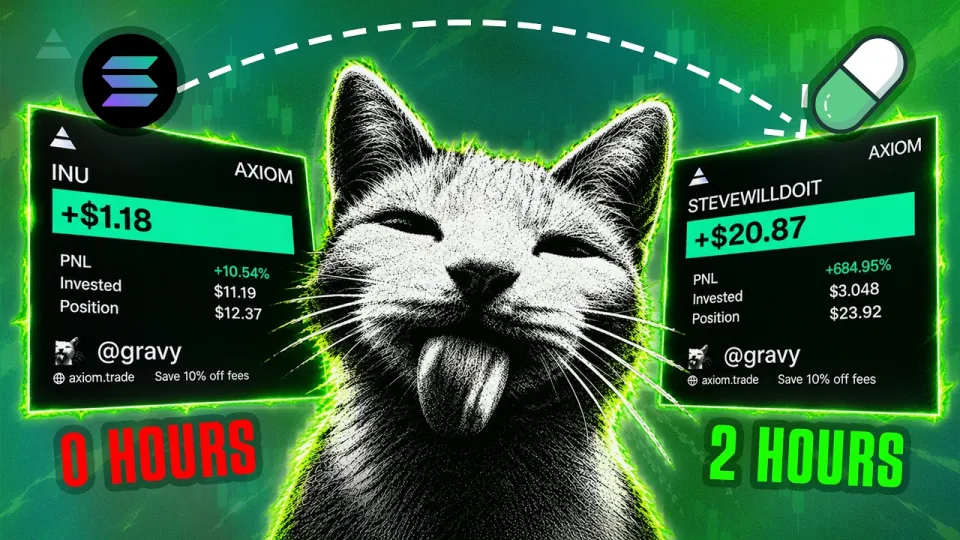
Video: I Tried Trading Memecoins with Just $10
Need articles like this for your video? They help promote it on YouTube and Google — order them in the Telegram bot @sat_sit_bot. The bot writes and publishes the articles itself (with your YouTube video embedded) on popular topical websites (no ads). Try it free: 50 articles on us.
· based on the channel gravy
Key takeaways
- Five real meme coin trades, each buy capped at 0.05 SOL — a portfolio under $10 at Solana prices.
- Tickers covered: STEVEWILLDOIT, NPC, MET (Meteora), PUMPY the Trader and UNTXD.
- Trades were routed through Axiom, which advertises 2x cashback and 15% lower fees via referral.
- A 0.05 SOL buy on a 1% fee tier costs roughly 0.0005 SOL per side — small, but not zero against a $10 stack.
- The X Money coin meta is tied to e/acc and Cream — narrative, not fundamentals, drives these moves.
You can trade meme coins with $10, but only if every buy stays small enough that fees and slippage cannot wipe the position before the narrative plays out. The practical version of that rule is a hard cap of about 0.05 SOL per entry, which is exactly how the five trades in gravy's $10 experiment were sized, all routed through Axiom's trading terminal. The catch is that a small stack forces you to be right about narrative timing rather than about size, because there is no room to average down.
What a $10 meme coin portfolio actually buys you
Ten dollars on Solana is roughly 0.05–0.07 SOL depending on price, which means a single buy at the 0.05 SOL cap uses most of the stack. That is not a bug, it is the constraint that defines the strategy: you are trading one position at a time, taking profit or cutting fast, and recycling the same capital.
The fee math is the part beginners skip. A typical pump.fun or Axiom swap charges a platform fee plus a liquidity provider fee plus priority tip, and on a 1% tier a 0.05 SOL buy costs about 0.0005 SOL per side. Round trip that is around 0.001 SOL — trivial in absolute terms, but it is 2% of a 0.05 SOL position before you have made a cent. Add 1–3% slippage on a thin new pair and a flat trade quietly becomes a 5–8% loss.
That is why the honest answer to "can you trade memecoins with a small portfolio" is yes, but the smaller the balance, the more the trade has to move to be worth taking. A 20% gain on 0.05 SOL is 0.01 SOL; after fees and slippage you keep maybe 0.008 SOL. You need repeatable 30–50% moves, not 5% scalps.
How the five trades were picked and managed
Each of the five entries followed the same loop: find a ticker with a live narrative, buy under 0.05 SOL, set a mental invalidation, and exit on strength or on a broken thesis. The tickers were STEVEWILLDOIT, NPC, MET (the Meteora-related coin), PUMPY the Trader and UNTXD.
- Identify the meta first. Before opening a chart, ask which story is currently pulling money: a personality, a protocol, a meme format, an AI-agent angle. The X Money coin meta is the clearest example — it ran on e/acc and Cream associations rather than on any product.
- Check that the ticker is the recognised one. Copy-paste the contract address from the source, never search by name. Impersonator tokens with identical names are the default scam on Solana.
- Size at 0.05 SOL or less. If the spread is wide or liquidity is thin, size smaller or skip. A position you cannot exit is not a position.
- Decide the exit before entry. Small accounts die from holding too long, not from buying wrong. A 2x on a 0.05 SOL buy is 0.05 SOL of profit — take part of it.
- Log the result. The most common complaint under the video was that the total PnL was never shown, which is exactly the number a small trader needs to track to know whether the loop works.
Where small-account meme coin traders lose money
Most losses on a $10 stack come from three repeatable mistakes rather than from bad luck. The first is buying a dip in a coin that has already lost its narrative — if the story is dead, the dip is not a discount, it is the exit liquidity of someone faster. The second is selling a 20–40% loss in panic and then watching the same coin run without you, which usually means the original entry was too large for the trader's tolerance, not that the coin was wrong. The third is chasing after the move has been tweeted about by accounts with real reach.
A useful filter: if you cannot explain in one sentence why a stranger would buy this ticker in the next hour, you are the exit liquidity. Narrative trading is about being early to a story that is easy to retell, and the retelling is what brings the buyers.
Managing a position when your whole stack is one buy
With $10 there is no portfolio construction, only sequencing, so risk management becomes a timing discipline. Take partial profit into the first vertical move rather than waiting for a target, keep a hard rule that no single trade risks more than the full 0.05 SOL, and accept that being flat is a position.
Liquidity matters more than market cap at this size. A token with a few thousand dollars of pooled liquidity will move 15% on your own 0.05 SOL exit, so check the pool before you enter and prefer pairs where your size is a rounding error. On Axiom, the route preview shows the expected output and price impact before you sign — read it every time.
Common questions from small-balance traders
"How do you find coins with good narratives so consistently?" Build a short list of accounts and communities that consistently surface metas early, and curate the feed aggressively — a timeline full of noise is the single biggest handicap. Then verify the story yourself instead of trusting the post.
"Why does my coin dump right after I buy the dip?" Because the dip you bought was distribution, not accumulation. Check whether volume is fading and whether the original catalyst is still live; if the narrative is stale, the bounce is a gift to sellers, not buyers.
"Is one trade at a time realistic?" For a $10 stack, yes — splitting into five $2 positions means fees and slippage eat a larger share of each. Concentration is the only way small capital produces a visible result.
"Should I use a referral link for lower fees?" Fee discounts compound when you trade often, but they never fix a bad entry. Treat any referral as a small edge on top of a working process, not as the process itself.
Useful links
- Axiom trading terminal with referral perks (2x cashback, 15% lower fees): https://axiom.trade/@gravy
- The Trenches Discord: https://discord.gg/W7TqkExcSd
- Free Axiom imports and trade signals (NFA): https://discord.gg/9W5j3XUgYB
- gravy on X: https://x.com/gravyski
- Leverage trading with 20% futures fee reduction: https://www.bitbase.com/landing-page/trading-earning-Gra?ref=8CYOGY
The takeaway for a ten-dollar account
Trading meme coins with $10 is a training exercise in narrative timing and exit discipline, not a path to meaningful income — the fees are survivable, but the position sizes mean one good call and one bad call roughly cancel out. What the five-trade experiment shows is that a hard size cap, a verified contract address and a pre-planned exit are enough to keep a tiny account alive long enough to learn. Anyone repeating this should track total PnL across all trades, because that single number is the only honest scoreboard. The breakdown comes from the gravy channel, which trades these setups on Solana and documents the reasoning rather than just the result. If you want to run the same experiment, start with the Axiom referral link and keep every buy under 0.05 SOL until the process is repeatable.
Questions & answers
Can you really trade meme coins with only $10?
Yes, technically — $10 on Solana is around 0.05 SOL, enough for one small entry at a time. Fees and slippage of roughly 2–5% per round trip are survivable at that size, but the position must move 30% or more to produce a result worth the risk. Treat it as practice capital, not income.
How much do fees eat on a 0.05 SOL meme coin trade?
On a 1% fee tier, a 0.05 SOL buy costs about 0.0005 SOL per side, so a round trip is roughly 0.001 SOL before slippage. That is only 2% of the position, but thin new pairs can add several percent of price impact on entry and exit, which is where small accounts actually bleed.
Why do meme coins pump right after I sell at a loss?
Usually because the entry was too large for your tolerance, so a normal 20–40% drawdown felt like a catastrophe and you exited into a temporary flush. If the underlying narrative is still live and volume has not dried up, the move often resumes — the fix is smaller size and a pre-defined invalidation level, not holding blindly.
How do you find meme coins with strong narratives before they run?
Curate a short list of accounts and communities that surface metas early, then verify the story yourself: who is behind the ticker, what association makes it retellable, and whether liquidity is deep enough to exit. A clean feed plus one-sentence thesis per coin beats scrolling a noisy timeline.
Source: I Tried Trading Memecoins with Just $10 · Markdown version